
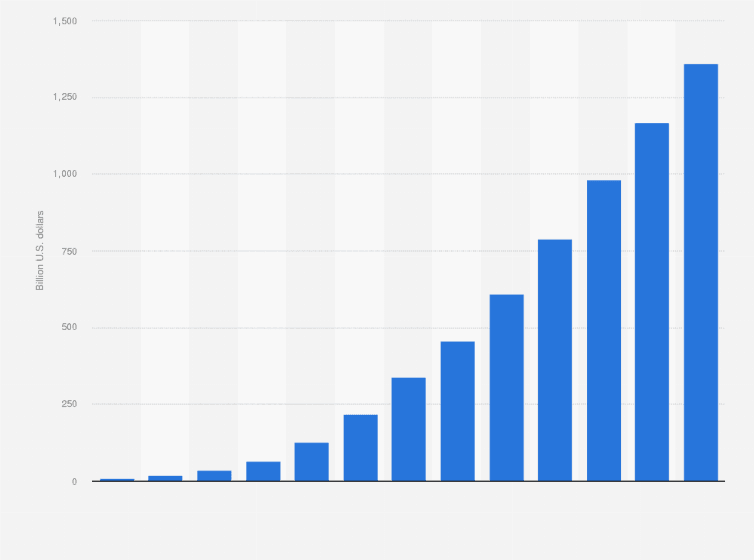
AI does not need to "close" a transaction to influence it.
In most workflows, its power lies upstream — shaping discovery, shortlists, and perceived credibility.
To make this concrete, we estimate AI-Influenced Revenue using a transparent, conservative formula:
AI-Influenced Revenue =
TAM (annual spend) × AI usage rate × Influence probability × Incremental impact factor
Where:
- AI usage rate = % of buyers using AI during the decision process
- Influence probability = likelihood AI meaningfully alters the shortlist or final choice
- Incremental impact factor = portion of spend attributable to AI influence (vs. traditional channels)
Because hard attribution data is still emerging, we model Low / Medium / High scenarios and clearly separate:
- Measured inputs (spend, adoption)
- Inferred multipliers (influence, incrementality)
This avoids hype while still capturing the scale of what's already happening.
AI Influence by Industry Workflow
Comparative Impact Table
Reading this table:
- Low = conservative, defensible today
- Medium = reasonable near-term reality
- High = optimistic but plausible as AI becomes transaction-ready
| Industry | Decision Moment | Annual Volume | AI Adoption | Influence Evidence | Assumed Multipliers | Estimated AI-Influenced Revenue | Evidence Quality | Who Pays |
|---|---|---|---|---|---|---|---|---|
| B2B Procurement | Vendor discovery, RFP shortlisting, supplier selection | ~$32.8T global B2B e-commerce (>$100T incl. offline)E | ~15%D 92% of CPOs exploring AI; ~37% piloting |
| 20% influenced × 20% incremental | $984B | Medium–Strong (enterprise surveys + case studies) | Buyers (procurement savings %); suppliers (shortlist inclusion, win rate) |
| Consumer E-Commerce | Product discovery, comparison, "best for X" recommendations | ~$7.4T global e-commerceI | 50%F 38–59% already using AI in shopping; trending 60%+ |
| 30% influenced × 10% incremental | $222B | Strong (Adobe analytics + large consumer surveys) | Brands & retailers (share of AI recommendations, revenue per visit) |
| Travel & Tourism | Destination, itinerary, hotel & flight selection | ~$8.6T global travel spendM | 50%AF 58% of U.S. travelers using AI; global ~40%+ and rising |
| 25% influenced × 10% incremental | $215B | Medium (strong usage data; limited conversion A/Bs) | Hotels, airlines, tourism boards (AI itinerary inclusion) |
| Real Estate & Mortgages | Home discovery, agent selection, mortgage comparison | ~$10T global residential sales (est.) | 75%R 82% of Americans use AI for housing info; 67% have used ChatGPT |
| 15% influenced × 10% incremental | $150B | Medium (strong adoption; limited transaction attribution) | Portals, brokers, lenders (AI-sourced leads) |
| Automotive | Model selection, price comparison, dealer choice | ~$3.5T global auto sales | 40%C 44% of shoppers already use AI |
| 35% influenced × 10% incremental | $122B | Strong (survey + behavioral metrics) | Dealers & OEMs (lead conversion); buyers (price savings) |
How to Interpret These Numbers
These figures are not forecasts.
They are snapshots of influence already in motion.
In every category, AI's role follows the same pattern:
- AI reshapes discovery
- Shortlists narrow around AI-favored options
- Winners compound attention, trust, and revenue
That compounding effect is exactly what Second Wind is designed to control.
Why This Matters
AI-influenced purchasing is already measurable.
It is already redirecting hundreds of billions of dollars annually — quietly, upstream, and at scale.
The only open question for companies is simple:
When AI is asked "who should I choose,"
does your name come up — clearly, confidently, and credibly?
Second Wind exists to make sure it does.